Skills mapping and assessment across the entire employee lifecycle, translated into more accurate hiring, more roles filled internally and stronger retention, with a measurable impact on business results.
Leading organizations use skills to break down and rebuild jobs and to adapt quickly to change, gaining a competitive edge in the future world of work.
Sources: LinkedIn Economic Graph, Skills-First Report · Deloitte, The Skills-Based Organization · World Economic Forum, Future of Jobs Report 2025
Want to see how a skills-based model can improve business results in your organization?
Talk to an ExpertThe output is a profile for each job family, detailing the knowledge, skills, experience, values, motivations and behaviors that matter most, plus a skills map with the required level for every role.
Analysis of job descriptions and the organization’s knowledge sources, such as the HR system.
Our AI scans the largest job boards in Israel and worldwide and extracts the most in-demand skills for each job family.
Insights from leading analyst reports: Gartner, World Economic Forum, Josh Bersin.
| Role | Persuasive communication | Negotiation | Understanding customer needs | Pipeline management | FutureWorking with data | Team leadership |
|---|---|---|---|---|---|---|
| Inside Sales Rep | ||||||
| Field Sales Rep | ||||||
| Key Account Manager (KAM) | ||||||
| Sales Team Lead |
| Role | Candidate assessment | Relationship building | Pipeline management | FutureWorking with HR data | Advising management | FutureChange management |
|---|---|---|---|---|---|---|
| Recruiting Coordinator | ||||||
| Senior Recruiter | ||||||
| HR Business Partner (HRBP) | ||||||
| OD Manager |
| Role | Active listening | Problem solving | Product knowledge | Conflict management | FutureWorking with AI tools | Team leadership |
|---|---|---|---|---|---|---|
| Customer Service Rep | ||||||
| Technical Support Rep | ||||||
| Customer Success Manager | ||||||
| Contact Center Lead |
We integrate with your enterprise systems and your existing skills taxonomy. If you don’t have a taxonomy yet, we’ll build one with you.
Every employee is assessed on skills from the organization’s skills map, which shows not only their fit for their current role but also for other roles across the organization.
Assessments are modular: choose the combination that fits your organization and population.
Everyday dilemmas from the role
Statements for each skill level
Peers, direct reports, HR or an external consultant
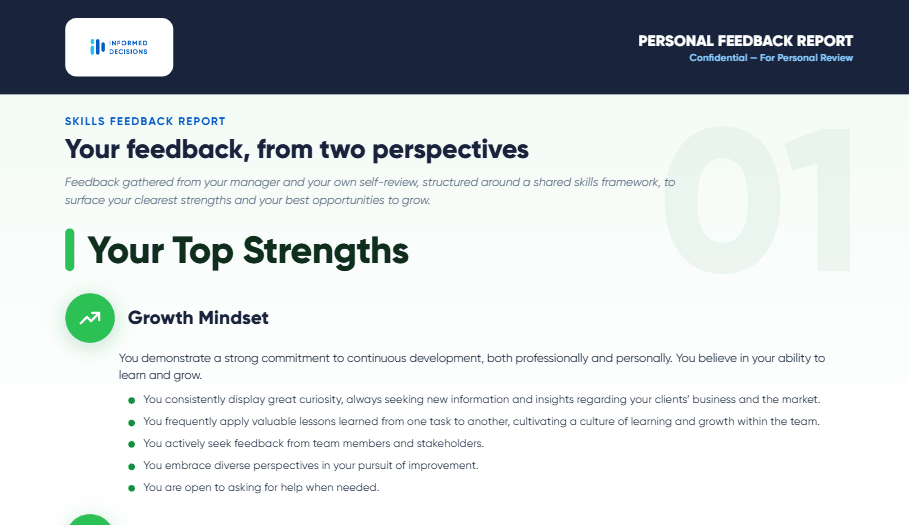
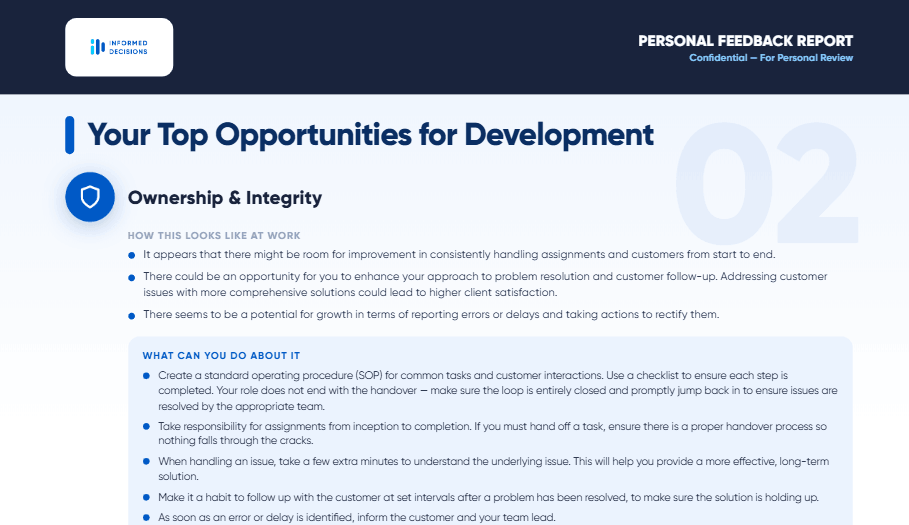
Each employee receives a report with their top strengths, development opportunities, how these show up at work, what they can do next and recommended learning resources.

Mapping and assessment data come together into insights at two levels:
The organization’s strongest and weakest skills, broken down by business unit, direct manager and other variables.
Organizational and individual training plans based on the gaps identified.
Tracking how skills change across the organization over time.
Measuring how training and interventions affect skill levels.
Entire organization · 1,240 employees
Job family: Sales · 310 employees
Role: Key Account Manager (KAM) · 42 employees
Skill overlap between roles creates a map of career paths. Employees see where they can grow, and managers see who’s ready for the next role.
Lateral and vertical, based on skill overlap.
Decisions based on data, not connections.
Filling skill gaps in units from within the organization.
Line thickness shows skill overlap between job families. Click a family to see where it leads.
Line thickness shows skill overlap between roles. Click a role to see where it leads.
Fit is calculated from the individual skills assessment. Click a role to see where it leads.
Want to see the skills and career map on your own data?
Book a DemoWe measure the impact in financial terms. HR goes to leadership with numbers that show how much the shift to a skills-based model has saved and earned for the organization.
Every role filled internally saves the cost of external hiring, onboarding and time to productivity.
Visible career paths reduce turnover among strong employees, and every departure avoided saves a replacement cost.
Employees in roles that match their skills reach full productivity faster and perform better.
Investment goes to the gaps that actually exist instead of broad training for everyone.
Want to know the expected impact in your organization?
Talk to an ExpertWe’d love to get to know your organization and show you how this could work for you.
Talk to an ExpertWe’ve received your details. One of our experts will be in touch shortly.